What Does Theme Mean in Art What Does Charcoal Mean in Art
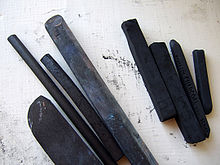
4 "vine" charcoal sticks and 4 compressed charcoal sticks. Drawing materials.
Artists' charcoal is a form of a dry out art medium made of finely ground organic materials that are held together by a gum or wax binder or produced without the employ of binders past eliminating the oxygen inside the material during the product process.[one] These charcoals are often used past artists for their versatile properties, such every bit the rough texture that leaves marks less permanent than other visual arts media.[2] Charcoal can produce lines that are very calorie-free or intensely black, while existence hard to remove completely. The dry medium can be practical to virtually whatever surface from shine to very fibroid. Fixatives are often used with charcoal drawings to solidify the position to prevent erasing or rubbing off of charcoal dusts.
The method used to create artists' charcoal is like to that employed in other fields, such as producing gunpowder and cooking fuel. The type of woods material and grooming method allow a variety of charcoal types and textures to exist produced.[three]
Types [edit]
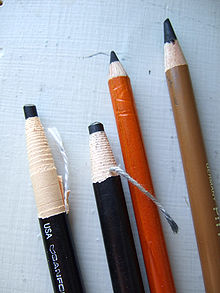
A selection of charcoal pencils
In that location are various types and uses of charcoal as an art medium, but the ordinarily used types are: Compressed, Vine, and Pencil.
Vine charcoal is a long and thin charcoal stick that is the result of burning grape vines in a kiln without air. It comes in shades of greyness.[iv]
Willow charcoal is a long and sparse charcoal stick that is the result of called-for willow sticks in a kiln without air. It is darker in colour than vine charcoal.[iv]
The removable properties of willow and vine charcoal, through dusting and erasing, are favored by artists for making preliminary sketches or basic compositions. This also makes such charcoal less suitable for creating detailed images.
Compressed charcoal (as well referred as charcoal sticks) is shaped into a block or a stick. Intensity of the shade is adamant by hardness. The amount of gum or wax binders used during the production process affects the hardness, softer producing intensely blackness markings while firmer leaves light markings.[5]
Charcoal pencils consist of compressed charcoal enclosed in a jacket of wood. Designed to be similar to graphite pencils while maintaining most of the properties of charcoal, they are often used for fine and crisp detailed drawings, while keeping the user'southward manus from being marked.[6]
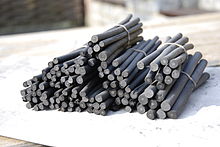
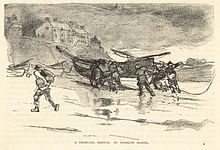
Other types of artists' charcoal such as charcoal crayons were developed during the 19th century and used past caricaturists.[seven] Charcoal powders are used to create patterns and pouncing, a transferring method of patterns from 1 surface to another.[ citation needed ]
There are broad variations in artists' charcoal, depending on the proportion of ingredients: compressed charcoal from burned birch, dirt, lamp black paint, and a pocket-sized quantity of ultramarine. The longer this mixture is heated, the softer it becomes.[8]
Fine art techniques [edit]
Paper used with artists' charcoal can vary in quality. Rough texture may allow more charcoal to attach to the paper. The utilise of toned paper allows different possibilities as white oil pastels (commonly referred to by the brand proper name Conté) can exist used in combination with charcoal to create contrast.[9]
Hatching [edit]
Hatching is a method in which thin, dark lines are continuously placed parallel to each-other. When done with charcoal, it comes out smoother and darker.
Rubbing [edit]
Rubbing is done by pressing a sheet of paper confronting a targeted surface, then rubbing charcoal against the newspaper to create an image of the texture of the surface.
Blending [edit]
Blending is done to create smooth transitions between darker and lighter areas of a drawing. It can also create a shadow consequence. Two common methods of blending are, using a finger to rub or spread charcoal which has been practical to the paper or the use of paper blending stumps also called a Tortillon. Many adopt to utilise a chamois, which is a soft foursquare slice of leather.
Lifting (Erasing) [edit]
Erasing is ofttimes performed with a kneaded rubber eraser. This is a malleable eraser that is oft claimed to be self-cleaning. Information technology tin be shaped by kneading it softly with easily, into tips for smaller areas or flipped inside out to clean.
History [edit]
Charcoal was frequently a primal component of cavern painting, with examples dating back to at least 28,000 years ago.[ten]
One of the oldest charcoal paintings is a picture of a zebra, institute at the Apollo cave in Namibia.[11] [ page needed ]
In the Renaissance, charcoal was widely used, only few works of fine art survived due to charcoal particles flaking off the sheet. At the end of the 15th century, a procedure of submerging the drawings in a gum bathroom was implemented to prevent the charcoal from flaking abroad. [ citation needed ] Charcoal paintings date as far dorsum every bit ca.23,000 BC. Since and so, many cultures take utilized charcoal for art, camouflage, and in rites of passage. Many ethnic people from Australia, parts of Africa, Pacific Islands, parts of Asia, and others still do body painting for rites of passage including child birth, weddings, spiritual rituals, war, hunting, and funerary rites. Many artists employ charcoal because of its unique night black strokes. The weak structure of charcoal causes the fabric to chip off onto the sheet. [ commendation needed ]
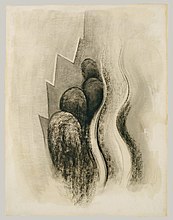
Throughout western art history, artists well known for other mediums have used charcoal for sketching or preliminary studies for terminal paintings. Examples of gimmicky artists using charcoal as a primary medium are Robert Longo, William Kentridge, Dan Pyle and Joel Daniel Phillips.
Gallery [edit]
-
-
-
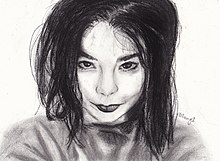
Contemporary cartoon of vocalist Björk done in charcoal
References [edit]
- ^ "Charcoal: powdered, compressed, willow and vine". Muse Art and Design. September 7, 2011. Archived from the original on August 31, 2012. Retrieved September xv, 2013.
- ^ Harris, Peter J F (1999). "On Charcoal". Interdisciplinary Science Reviews. 24 (4): 301–306. doi:ten.1179/030801899678966. Retrieved September 15, 2013.
- ^ Lindquist, Evan. "How to Make Drawing Charcoal". Retrieved September xviii, 2013.
- ^ a b "The Best Vine and Willow Charcoal for New Furnishings on the Page". ARTnews.com. 2021-05-07. Retrieved 2022-04-eleven .
- ^ Saitzky, Steven (1987). "Carbon Based". Art Hardware: The Definitive Guide to Artists' Materials. Watson-Guptill. ISBN9780823002672. Archived from the original on 2013-09-21. Retrieved 2013-09-xvi .
- ^ Steven, Pearce (2017). 101 textures in graphite & charcoal. Lake Wood, CA: Quayside Publishing Group. pp. 8–nine. ISBN978-1633224100. OCLC 987022498.
- ^ Elisabeth, Mary. Foster, Niki (ed.). "What are Charcoal Pencils?". Retrieved 2013-09-15 .
- ^ "How to Choose Drawing Materials: Compressed Charcoal- How it's fabricated?". RUSART Fine art Supplies. Archived from the original on January 12, 2014. Retrieved September 18, 2013.
- ^ Vebell, Victoria (2004). Exploring the Basics of Drawing (1st ed.). Cengage Learning. ISBN9781401815738.
- ^ "An archaeologist has discovered charcoal drawings that are 23,000 years old..."
- ^ Kleiner, Fred S. (January 1, 2012). Art Before History. Gardner's Art Through the Ages; A Global History (14th ed.). Street Boston, MA 02210: Wadsworth: Cengage Learning. ISBN978-0495915430.
{{cite book}}: CS1 maint: location (link)
Source: https://en.wikipedia.org/wiki/Charcoal_(art)

Post a Comment for "What Does Theme Mean in Art What Does Charcoal Mean in Art"