Hunter-gatherers subsidize families...for the benefit of everyone
© 2022 Gwen Dewar, Ph.D., all rights reserved
Egalitarian, cooperative, and fiercely-protective of their personal freedoms, hunter-gatherers are as well very practical. They know that parents can't afford to raise kids without aid. And then everybody pitches in — and society thrives.
Family subsidies. Childcare aid. Support for parents struggling to make ends meet.
We sometimes talk equally if these policies are the inventions of modern-twenty-four hours reformers. After all, isn't the whole history of our species a tale of rugged individualism? Survival of the fittest?
Aren't we all descended from the evolutionary "winners" — ancestors who pulled themselves up by their own bootstraps?
It might audio scientific, just information technology'southward wrong.
Parents have always needed help. In fact, our species is especially dependent on extra-parental helpers to survive. And this was merely every bit true in the past — when our ancestors lived by hunting and gathering — equally it is today.
Have you ever tried walking ten miles through the bush with a baby on your back and toddler in tow? While keeping an center out for predators? And digging upwards yams or collecting bird eggs?Good luck.
A mother didn't take the option of staying home all day — leaving the foraging to someone else. So as now, it was a question of economics. To raise children — to feed the family — both parents needed to participate in economic activity. Fifty-fifty then, two parents weren't enough.
We can come across this clearly if we look at modern-day hunter-gatherers — the people whose life-means most closely resemble those of our foraging ancestors.
Throughout the earth, there are a few of these societies left, and they provide united states with vital insights.
When anthropologists take studied hunter-gatherer economic science, they've establish that parents aren't cocky-sufficient.
They don't produce plenty to feed their own families. They aren't solely responsible for childcare. They get help. Crucial, necessary assistance.

Consider the Hadza people, who live in the Lake Eyasi region of Tanzania.
In his report of the Hadza, Frank Marlowe institute that the average developed Hadza woman gathered approximately 3016 calories' worth of nutrient each day. But this was true just for women who didn't have whatever children under the historic period of 8.
Add young children to the equation, and women weren't able to gather as much food each day. Particularly women with babies.
The average breastfeeding woman gathered only 1713 calories worth of nutrient per twenty-four hour period. At precisely the time when mothers needed more calories (to feed their babies), their foraging "paychecks" were taking a big striking.
How were Hadza mothers making up for the economic shortfall?
Fathers were stepping up their foraging efforts. During the first year postpartum, married men increased their average daily contributions from about 2990 calories to 3851 calories per day.
Simply that still left these families suffering a internet loss. They couldn't brand ends meet past themselves.
So other people — like grandmothers — contributed. Other people made upwards the difference.
And that'due south how Hadza babies survive to get Hadza adults.
Kim Colina and Ana Magdalena Hurtado have documented a like design amidst other foraging groups in Due south America.
Married couples with immature children don't produce plenty food to be self-sufficient. On the contrary, they experience stunning deficits during the child-rearing years — falling short by thousands of calories each mean solar day.
Yet they don't starve to death. Nor are they considered failures. Families are provisioned by other adults (including non-relatives) considering it's necessary for children to abound and thrive (Colina and Hurtado 2009).
Then there is the type of help that we might phone call "daycare" or "babysitting."
That hypothetical foraging scenario I presented earlier? About the female parent bringing her baby and toddler along? It doesn't typically happen that way.
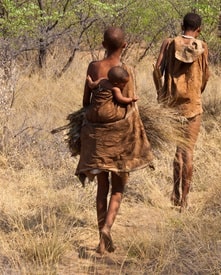
A breastfeeding mother volition bring her baby with her. Merely older children? She oft leaves them at home, in camp. And this works just because hunter-gatherers bask a free, cooperative form of daycare.
Children tend to spend their time in multi-age playgroups. The oldest kids serve as babysitters, with dorsum-upward from the adult neighbors who stay backside to monitor things and practise chores (Konner 2010; Marlowe 2010).
So hunter-gatherer parents get free daycare for their toddlers and "big kids", as well as direct economic assistance. And in many cases, mothers get substantial aid with infant intendance, besides.
For example, in a recent analysis of v dissimilar traditional foraging societies (in Africa, Australia, South America, and the Philippines), mothers provided most half of all care-giving to their ain babies. The rest was contributed by older siblings, fathers, and grandmothers (Kramer and Veile 2018).
Even among the Kalahari San — people known for very high levels of maternal care — mothers don't do it lonely. In one report, Melvin Konner constitute that non-mothers accounted for about 20-25% of all concrete contact that babies had received over their outset 20 months (Konner 2010).
Just how common are these income subsidies and childcare benefits? Pretty darned common — peculiarly when things are tough.
Modern-twenty-four hours hunter gatherers live in a diverseness of environments, and they each accept their own, distinct cultures. And so the details vary.
But as a full general dominion, care-giving assistance increases as a function of hardship. The more difficult it is to make a living, the more likely parents are to receive help (Martin et al 2020).
And food-sharing? Making sure that every group member gets what he or she needs? That's the economical boulder of all hunter-gatherer societies.
But why? Why do hunter-gatherers conduct like this? Why don't they acquit more…selfishly?

Information technology isn't — as libertarian icon opens in a new windowAyn Rand once suggested — because hunter-gatherer people are simple-minded conformists. Information technology isn't because hunter-gatherers don't value personal freedom, or private rights.
On the contrary, the consensus of anthropologists who take studied foragers is that these folks are tremendously invested in personal autonomy. There are no formal hierarchies. All adults do equal decision-making power. They don't tolerate bossiness. They don't dominate effectually their kids, let alone boss around each other.
And when it comes to economics, hunter-gatherers are practical. They know they can't survive without sharing nutrient. Not in the long run.
Sure, a childless adult — an unmarried human with outstanding hunting skills — might be capable of feeding himself without anybody else'south aid. Today.
But he wouldn't have survived to adulthood if his parents hadn't had help.
And the others in his group? The people he relies on for group defense? For exchanges of resources? For shared information most the surround?
Without babyhood subsidies, it's likely thatthey wouldn't accept survived either.
But as crucially, sharing helps this human cope with life'southward unpredictable twists and turns. Hunters frequently experience streaks of bad luck, and fail to bag whatsoever prey for many days in a row. Foragers sometimes become ill, or injured. What then? Sharing is their insurance policy, their lifeline.
What near our world? The mod world of manufacture and mass communication? Things aren't so dissimilar.
Granted, we're non every bit egalitarian equally hunter-gatherers. We don't live in pocket-size bands. Our society'south economy isn't based on foraging.
But those of us who are parents nonetheless demand aid. In fact, in some respects we're more burdened, more needy.
Almost of us lack the gratis childcare that hunter-gatherers take for granted. In pursuit of employment, we relocate to places far from other adult family members. Our kids crave more time — and more all-encompassing training — to develop the necessary skills for economic independence. It's very costly.
Moreover, just like our hunter-gatherer ancestors, we are securely interconnected. Other people's children — their successes, their failures — have an impact on the remainder of lodge.
Poverty puts children at adventure for costly, chronic health problems. Information technology fuels crime rates. It causes poor educational outcomes (Cooper and Stewart 2020). And all of this lowers a gild'due south economic productivity.
A recent analysis of the U.S. economy estimates that child poverty costs more than a trillion dollars a year — 5.4% of the U.South. gross domestic product (McGloughlin and Rank 2018).
That's dramatic, but there's even more: there are the hardships experienced by other, more economically fortunate families.
You don't have to have fallen to the very lesser of the socioeconomic ladder to experience adversity and toxic stress.
For example, in the United States today, the unmet demand for affordable, quality childcare is causing major disruption, forcing many parents to quit their jobs, or reduce their working hours.
Information technology's also articulate that families are impacted past the high cost of health intendance. What happens when parents are forced to make terrible tradeoffs — like deferring medical intendance to pay the rent?
And what well-nigh kids with special problems — like developmental disorders, medical conditions, learning disabilities?
Parents tin can't possibly set these problems on their own, and when their struggling children turn into struggling adults, society at large pays a price.
Yet the myth persists — the myth of self-efficiency, the myth that parenting is a distinctly private enterprise. An expensive, messy, vanity project that parents are supposed to handle on their own.
What? You started a hobby of hot-housing exotic flowers, and at present information technology's too hard for you? You need someone to help you monitor the humidity levels while you're at work? You can't afford to buy enough fertilizer? Y'all plants aren't getting enough sunlight? That's sad, but it'south not my problem.
Our ancestors didn't arroyo parenting this mode. If they had, they would have died out. Because of form parentingisn't a personal vanity projection. It wasn't then. Information technology isn't now. When it comes to the success or of the next generation, we're all of us stakeholders. Whether we're parents or not.
Practise we want to live in a society that is rubber and secure? A guild with less criminal offense, and fewer public health threats?
Practise we want to live in a society where we help children reach their total potential, and so they can grow up to go productive, skilled, reliable allies? The sort of people who will solve problems, pay the bills, innovate, build, create, find, protect, and make the world a better place?
It'southward time to embrace our heritage, and re-commit to the basic values that make usa human.
References: Hunter-gatherers and parental helpers
Apicella CL, Marlowe FW, Fowler JH, Christakis NA. 2012. Social networks and cooperation in hunter-gatherers. Nature 481:497–502.
Allen-Arave W, Gurven M, Hill Thousand. 2008. Reciprocal altruism, rather than kin selection, maintains nepotistic nutrient transfers on an Ache reservation. Evol. Hum. Behav. 29: 305–318
Bogin B. 2009. Childhood, adolescence, and longevity: A multilevel model of the evolution of reserve chapters in homo life history. Am J Hum Biol. 21(4):567-77
Bogin B, Bragg J, Kuzawa C. 2014. Humans are not cooperative breeders but practice biocultural reproduction. Ann Hum Biol. 41(4):368-80.https://b494abdb02635d922633488d1dea6e12.safeframe.googlesyndication.com/safeframe/1-0-38/html/container.html
Cooper K and Stewart K. 2020. Does Household Income Affect children's Outcomes? A Systematic Review of the Evidence. Child Indicators Inquiry: https://doi.org/10.1007/s12187-020-09782-0.
Crittenden A and Marlowe F. 2008. Allomaternal Care amidst the Hadza of Tanzania. Human Nature: An Interdisciplinary Biosocial Perspective 19(3): 249-262
Loma K and Hurtado AM. 2009. Cooperative convenance in South American hunter–gatherers. Proc. R. Soc. B 276 (1674): 3863-3870.
Konner Chiliad. 2010. The Development of Babyhood: Relationships, Emotion, Listen, Harvard University Press.
Koster J. 2011. Interhousehold meat sharing among Mayangna and Miskito horticulturalists in Nicaragua. Hum Nat. 22(4):394-415.
Kramer KL. 2010. Cooperative Breeding and its Significance to the Demographic Success of Humans. Annual Review of Anthropology 39: 417-436
Kramer KL and Veile A. 2018. Babe allocare in traditional societies. Physiology and Behavior 193(Pt A): 117-126
Marlowe F. 2010. The Hadza. Hunter-Gatherers of Tanzania. Berkeley, CA: University of California Press.
Martin JS, Ringen EJ, Duda P, and Jaeggi AV. 2020. Harsh environments promote alloparental care across human societies. Proc Biol Sci. 287(1933):20200758.
McLaughlin G and Rank MR. Estimating the Economic Cost of Childhood Poverty in the The states Social Piece of work Enquiry 42(two): 73–83.
Page AE, Thomas MG, Smith D, Dyble 1000, Viguier S, Chaudhary Northward, Salali GD, Thompson J, Mace R, Migliano AB. 2019. Testing adaptive hypotheses of alloparenting in Agta foragers. Nat Hum Behav. three(11):1154-1163.
Schoeppe S, Duncan MJ, Badland HM, Aisle S, Williams Southward, Rebar AL, Vandelanotte C. 2015. Socio-demographic factors and neighbourhood social cohesion influence adults' willingness to grant children greater contained mobility: A cross-sectional study. BMC Public Health. xv:690.
Sear R, Mace R. 2008. Who keeps children alive: a review of the effects of kin on child survival. Evol Hum Behav 29:i–eighteen.
Content final modified iii/17/2021
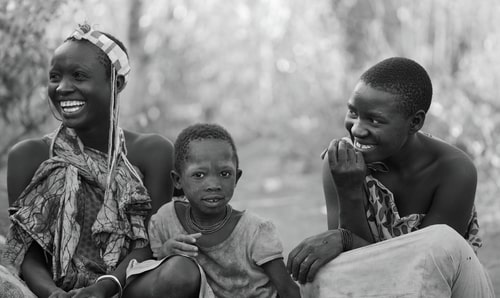
Title image of Hadza women with kid by Papa Bravo / shutterstock
Image of women digging up tubers most Lake Eyasi by federico neri / shutterstock
Image of mother walking in the Kalahari bush with an infant on her back cropped from a photograph by romitasromala / istock
Image of Huaorani mother (with red paint) belongings babe cropped from a photo by Zaruba Ondrej / shutterstock
Source: https://parentingscience.com/parents-need-help/

Post a Comment for "Hunter-gatherers subsidize families...for the benefit of everyone"